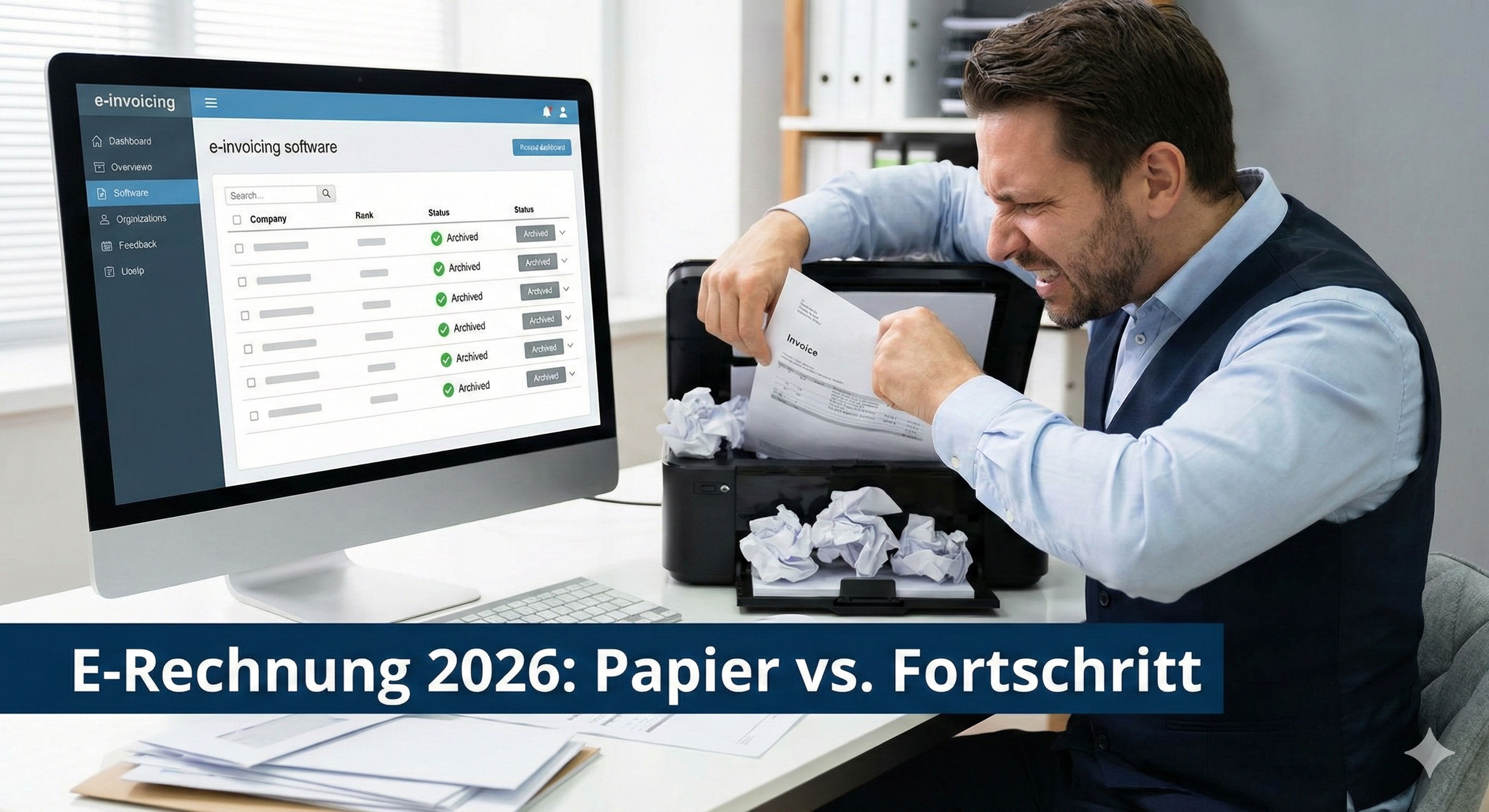
Yes, you may print an e-invoice, for example to read it or for your tax advisor (Steuerberater). However, the printout replaces neither sending nor retention. If mandatory e-invoicing applies to you, you must send invoices to domestic businesses (i.e. both parties established in Germany) electronically in a structured format: from 1 January 2027 if your total turnover in the previous calendar year was above €800,000; from 1 January 2028 almost all businesses. What is retained is always the original file.
Are you allowed to print an electronic invoice?
Yes. There is no provision that prohibits printing an e-invoice. You may put any invoice on paper as often as you like – for internal checking, for approval by management or simply because it is easier to work on paper with a pen.
What matters is what happens alongside. The German VAT Act (Umsatzsteuergesetz, UStG) defines the e-invoice as an invoice in a structured electronic format that can be processed automatically and complies with the European standard EN 16931 on electronic invoicing (Section 14(1) sentences 3 and 6 UStG). It is precisely this structured data set that is the original. A printout no longer contains it: machine-readable data becomes an image that an accounting system can no longer import.
The printout is therefore a copy – useful, but legally not what must be retained. Which formats count as a structured original is explained in our overview of the ZUGFeRD format.
Printing an e-invoice and sending it by post – is that still allowed?
Here the answer is: it depends on when you performed the supply and how high your turnover is. Contrary to frequent claims, the transitional periods for sending have not yet expired. What matters is not the invoice date but the time at which the supply was carried out – so you may still invoice a supply performed in December 2026 on paper in January 2027.
Under Section 27(38) UStG, staggered deadlines apply to the obligation to issue:
Until 31 December 2026 (inclusive), all businesses may continue to issue their B2B invoices as paper or PDF invoices. Sending on paper requires no consent of the recipient; a PDF does. This consent is not subject to any particular form – it can also arise tacitly from established practice, for example if the recipient has so far accepted and paid your PDF invoices without objection.
From 1 January 2027, businesses with a total turnover of more than €800,000 in the previous calendar year 2026 must issue their B2B invoices as e-invoices.
From 1 January 2028, the obligation to issue applies in principle to all remaining businesses. Only individual cases remain permanently exempt: small-amount invoices with a total amount (gross) not exceeding €250 (Section 33 of the VAT Implementing Ordinance (UStDV)), travel tickets (Section 34 UStDV), VAT-exempt supplies under Section 4 nos. 8 to 29 UStG and invoices from small business owners under Section 19 UStG (German VAT Act). We have compiled the details and exceptions in our guide to mandatory e-invoicing from 2027.
Small business owners under Section 19 UStG are permanently exempt from the obligation to issue (Section 34a sentence 4 UStDV as amended by the Annual Tax Act 2024 (Jahressteuergesetz 2024)). For them, nothing changes regarding sending by post – but it does regarding receipt.
The opposite direction is important: the obligation to be able to receive e-invoices has applied to domestic businesses for B2B supplies since 1 January 2025 – without exception, without a transitional period and regardless of company size. The law does not require any specific software for this; according to the Federal Ministry of Finance (BMF), an e-mail inbox is sufficient for receipt. So you can still take a little time before sending e-invoices yourself. You have had to receive them for a long time already.
And even where paper remains permitted, it has a practical price: the recipient has to enter the data manually. Experience shows that invoices that create work are paid later than those that can be booked automatically.
Is a PDF invoice valid? PDF vs. e-invoice
Since 2025, a plain PDF is not an e-invoice within the meaning of the UStG but an „sonstige Rechnung“ (other invoice, i.e. a paper invoice or an electronic invoice in a non-structured format, e.g. a plain PDF). It remains valid as long as there is no e-invoicing obligation (for example to private customers, for small amounts, for small business owners) or as long as the transitional rule applies: until the end of 2026 for everyone, in 2027 only up to a total turnover of €800,000 in the previous calendar year, in each case with the consent of the recipient. ZUGFeRD, the German hybrid e-invoice standard published by FeRD (Forum elektronische Rechnung Deutschland), is an e-invoice from the BASIC profile upwards; what matters is the embedded XML part.
Confusing PDF with e-invoice is the reason why many businesses consider themselves further ahead than they are. For VAT purposes, a PDF generated on screen has been an „other invoice“ since 1 January 2025, not an e-invoice. It is digital, but not structured: an accounting system cannot read fields from it, at best it can recognise text.
The difference has two practical consequences. First, you may only send a PDF with the consent of the recipient, whereas paper needs no consent. Second, a PDF does not fulfil the obligation to issue as soon as it applies to you.
The exception is ZUGFeRD: here the structured data set is embedded as XML in the PDF. Humans see a familiar document, software reads the data. Such a hybrid document is a genuine e-invoice – a plain PDF is not. The profile does matter, however: the tax authorities recognise ZUGFeRD from version 2.0.1, with the exception of the MINIMUM and BASIC-WL profiles. These two do not contain all mandatory VAT invoice details in structured form and are therefore still treated as other invoices.
Paper, PDF or e-invoice: what is allowed when?
| Scenario | Paper | Plain PDF | Note |
|---|---|---|---|
| Domestic B2B – total turnover 2026 above €800,000 | no | no | E-invoice mandatory – until 31 December 2027 (inclusive) EDI also possible only with the recipient's consent |
| Domestic B2B – total turnover 2026 not exceeding €800,000 | yes – until 31 December 2027 (inclusive) | only with the recipient's consent | e-invoice mandatory from 1 January 2028 |
| Invoice to private customers (B2C) | yes | yes – with the recipient's consent | no deadline |
| Small-amount invoice not exceeding €250 (gross) / travel ticket / small business owner | yes | yes – with the recipient's consent | no deadline |
Important: the customer's consent does not lift the e-invoicing obligation. It is not a way to keep sending paper or plain PDFs with a total turnover above €800,000.
What sending by post actually costs
Besides the legal side, there is a simple business calculation. Postage, paper, toner, envelope and the minutes spent printing, folding and enveloping add up per invoice to an amount that becomes noticeable with a few hundred invoices a year – and with no benefit in return, because the data gets worse in the process, not better.
The loss of time weighs more heavily. An e-mail is delivered in seconds, while a letter takes one to two working days – and then more time at the recipient's end until someone types in the figures. If your payment due date is calculated from receipt of the invoice, you give away several days of liquidity at this point every single time.
Printing and filing digital invoices – the costly misconception
The more common and considerably riskier mistake does not happen when sending, but in your own files: an e-invoice arrives by e-mail, is printed out and filed – and the file disappears in the inbox or is deleted.
This does not meet the retention obligation. E-invoices must be retained in their structured original format; a printout or a scanned PDF does not replace the original (GoBD; Section 14b UStG). Since the Fourth Bureaucracy Relief Act, the retention period for invoices and accounting vouchers has been 8 years. For commercial books, annual financial statements and opening balance sheets, it remains 10 years – a distinction that is often overlooked in practice. The period begins at the end of the calendar year in which the invoice was issued – and it is extended for as long as the assessment period for the tax concerned is still running, for example during a tax audit (Betriebsprüfung).
Proper retention means three things: the document must be stored in an unalterable form, remain machine-readable and be retrievable within the period. For a digital document, a lever arch file meets none of these three requirements.
What does this mean for input VAT deduction?
Input VAT deduction does not automatically fail because you have printed out an invoice. However, it requires that you hold a proper invoice and can produce it if in doubt. This is exactly where the risk arises: if, during a tax audit, you only present the printout and no longer have the structured original, you bear the burden of proof that the invoice was proper.
In addition, breaches of the retention obligations are penalised in their own right: failing to retain invoices for eight years contrary to Section 14b(1) UStG is an administrative offence and can result in a fine of up to €5,000 (Section 26a(2) no. 2 and (3) UStG). If verifiable documents are missing entirely, the tax office (Finanzamt) may estimate the tax bases (Section 162 AO). So the printout is not a safety net – on the contrary, it means giving one up. Which errors in an e-invoice have which tax consequences is explained in our article on error classes.
When a printout still makes sense
There are good reasons to put an invoice on paper, and they should not be played down:
For checking the content and approval, when not everyone involved in the business has access to the system. For the building site, the workshop or the field service. For customers who explicitly want a paper document. And as a working copy, if you want to mark an item with a pen.
All of this is unproblematic – as long as the structured data record remains archived unaltered in parallel. The rule is not “don't print” but: print as much as you like, but treat the printout as what it is – a copy.
How to do it properly
Define the receiving channel: a fixed e-mail address for incoming invoices that does not end up in an employee's personal mailbox. A government portal is not mandatory for sending to business customers in Germany – e-mail is sufficient. The situation is different for invoices to public contracting authorities: there, the federal government and the federal states specify their own receiving channels, such as the federal OZG-RE portal (federal invoice receipt platform) or the Peppol network.
Secure the original first: store the received file unaltered before anything else happens to it. Do not rename it, do not convert it.
Check the invoice: check formal validity and the mandatory invoice details, ideally automatically against the rule set of the standard. The BMF letter (administrative guidance) of 15 October 2025 expressly distinguishes between format errors, business rule violations and content errors – it is best to keep the validation report together with the invoice.
Retain properly for 8 years: unalterable, retrievable, machine-readable – in the original format.
The period may be extended for as long as the tax assessment period is still running.
Only then print, if you need paper: as a working copy, never as a substitute for the document.
Send e-invoices by e-mail instead of by post
You send an e-invoice as a file by e-mail or via an invoicing portal. No printout, envelope or stamp is needed. How to create a ZUGFeRD invoice step by step is shown in our guide.
Read more: Guide to mandatory e-invoicing 2027, Archiving e-invoices and ZUGFeRD 2.x explained simply.
Legal position as at: November 2026
Note: Not tax or legal advice
This article is for general information only. It is not tax or legal advice for your individual situation and cannot replace such advice. It describes German and, where stated, EU law. Other jurisdictions are not covered. Although we research carefully, we cannot guarantee that the content is current, complete or correct. Legislation, case law and administrative guidance (for example, German Federal Ministry of Finance (BMF) circulars or EU initiatives such as ViDA) may change after publication. Please consult a German tax advisor (Steuerberater), a lawyer or another qualified professional for your specific situation. Our statutory liability remains unaffected.
Status: November 2026