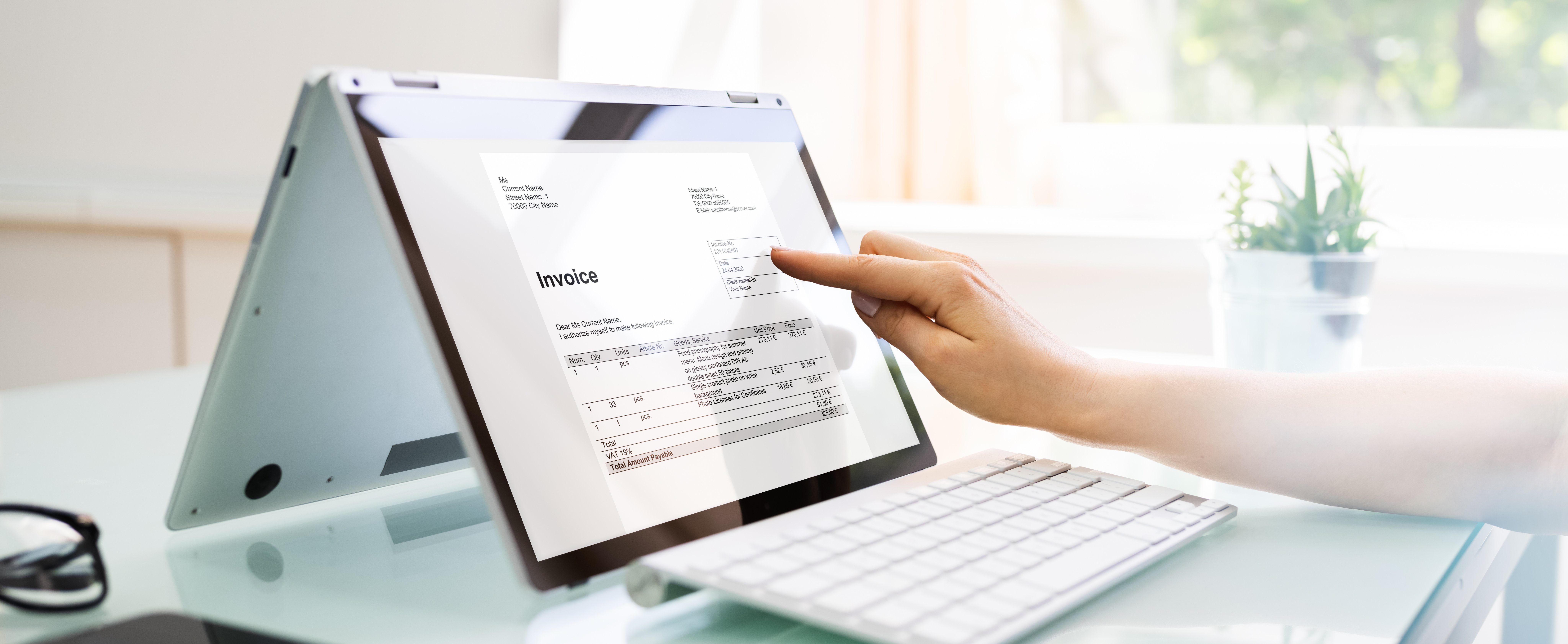
Introduction: why multilingual invoices transform your business
Imagine this: a promising business contact from France orders your products – but the invoice arrives in German. The result? Delayed payments, queries and, in the worst case, a lost customer. In a globalised business world, multilingual invoices are no longer a nice-to-have but a decisive competitive advantage.
Many international B2B customers prefer business documents in their own language. Sending multilingual invoices avoids queries and can therefore speed up payment from international customers.
In this comprehensive guide you will learn:
- ✅ Why multilingual invoices are business-critical
- ✅ Which legal requirements apply
- ✅ How modern AI technology simplifies their creation
- ✅ How to create international invoices with FaeBill in 5 minutes
What are multilingual invoices?
Multilingual invoices are business documents that present all relevant invoice information in the recipient's national language – while complying with all legal and technical standards such as ZUGFeRD, the German hybrid e-invoice standard published by FeRD (Forum elektronische Rechnung Deutschland), or XRechnung, the German CIUS (Core Invoice Usage Specification) of EN 16931, maintained by KoSIT.
The difference from translation
A multilingual invoice is more than a simple translation:
| Standard translation | Professional multilingual invoice |
|---|---|
| Word-for-word rendering | Context-aware business translation |
| Formatting often faulty | Country-specific formatting |
| No adjustment of units | Automatic localisation of units |
| Inconsistent technical terms | Standardised business terminology |
Practical example:
A German company sells machines to Italy. The product description "Hochleistungs-Fräsmaschine mit CNC-Steuerung" is not only translated as "Fresatrice ad alte prestazioni con controllo CNC"; the units of measurement, delivery terms and payment arrangements are also adapted to Italian business standards.
Why multilingual invoices are crucial for your business
1. Fewer payment delays
The problem: International customers who receive invoices in a foreign language need more time to check and approve them. If accounting first has to get documents translated, payment is delayed.
The solution: Invoices in the customer's own language are checked and approved more quickly. This can improve your liquidity and reduce the effort spent on dunning.
2. Professional brand image in international business
An invoice in your customer's native language signals:
- ✅ Respect for the partner's business culture
- ✅ Professionalism and international experience
- ✅ Customer focus and service orientation
- ✅ Trustworthiness as a reputable business partner
3. Avoiding costly misunderstandings
Unclear descriptions of goods or services quickly lead to queries or complaints. Precise translations help prevent such misunderstandings.
4. Observe language rules abroad
Some countries have their own language rules for business documents or may ask for a translation during an audit. Check the rules of the recipient's country before you invoice.
5. Competitive advantage in international tenders
In public and private tenders in other EU countries, the ability to conduct business in multiple languages is often used as a knock-out criterion or evaluation factor.
The challenge: why manual translations fail
Challenge 1: time and cost
Manual process:
- Create the invoice in German (15 minutes)
- Send it to a translation agency (1 day waiting time)
- Check and correct the translation (20 minutes)
- Transfer it into the invoicing system (10 minutes)
- Adjust the layout (15 minutes)
Total effort: ~60 minutes of working time + 1 day of delay + costs of €50-150 per invoice
Challenge 2: inconsistency
Manual translations by different employees or service providers result in:
- Different terminology for the same products
- Varying formatting
- Inconsistent payment terms
- Incorrect currency conversions
Challenge 3: scaling impossible
A medium-sized company with 50 international invoices per month would need:
- 50 hours of additional working time per month
- Costs of €2,500-7,500 per month for translations
- Dedicated staff for international processing
Conclusion: Manual multilingual invoicing is not scalable for growing companies.
The solution: automated multilingual invoices with AI
Modern SaaS solutions such as FaeBill rely on AI-supported translation technology that is used for business documents.
How does AI-based invoice translation work?
Step 1: context analysis
The AI does not just analyse individual words but understands the business context of your invoice:
- Industry and product category
- B2B vs. B2C communication
- Formal vs. informal tone
- Technical vs. plain language
Step 2: Intelligent translation
The AI translates taking into account:
- ✅ Industry-specific terminology
- ✅ Local business practices
- ✅ Standard commercial wording
- ✅ Cultural nuances
Step 3: Automatic localisation
In addition to the translation, the following are adapted automatically:
- Date and number formats
- Currency designations
- Units of measurement (metric/imperial)
- Address formats
- Payment terms
Step 4: Template integration
The translation is embedded in a professional, country-specific layout that meets the expectations of the target market.
Which languages are supported?
FaeBill currently offers five invoice languages:
| Language | ISO code | Main markets | Business relevance |
|---|---|---|---|
| 🇩🇪 German | DE | Germany, Austria, Switzerland | Home market, precise terminology |
| 🇬🇧 English | EN | UK, Ireland, international | Lingua franca of world trade |
| 🇫🇷 French | FR | France, Belgium, Luxembourg | Important EU market with its own standards |
| 🇮🇹 Italian | IT | Italy | Strong trading partner in mechanical engineering/fashion |
| 🇪🇸 Spanish | ES | Spain, Latin America | Access to growing markets |
ZUGFeRD and XRechnung: multilingual and standard-compliant
The challenge: standardisation vs. localisation
Since 1 January 2025, all domestic businesses (i.e. established in Germany) must be able to receive e-invoices (Section 14(1) sentence 5 in conjunction with Section 14(2) sentence 2 no. 1 UStG); the obligation to issue e-invoices in domestic B2B transactions is being phased in from 1 January 2027 and applies to all from 1 January 2028. Any format that complies with EN 16931 is permitted, for example ZUGFeRD 2.x (from the BASIC profile) or XRechnung. But how can structured, machine-readable data be combined with multilingual, human-readable documents?
The solution: hybrid documents
Modern invoicing software creates hybrid ZUGFeRD documents:
Layer 1: XML data (machine-readable)
The structured invoice data in XML format remains language-neutral and EN 16931-compliant:
<ram:InvoiceDateTime>
<udt:DateTimeString format="102">20250115</udt:DateTimeString>
</ram:InvoiceDateTime>
Layer 2: PDF representation (human-readable)
The visual representation is generated in the target language:
- German customer: "Rechnungsdatum: 15.01.2025"
- French customer: "Date de facture: 15/01/2025"
- English customer: "Invoice Date: 15 Jan 2025"
Advantage: The invoice is both standard-compliant (structured data) and customer-friendly (localised representation).
Best practice: what should be translated?
| Element | Translate? | Reason |
|---|---|---|
| Product names | ✅ Yes | Comprehensibility for customers |
| Product descriptions | ✅ Yes | Avoiding misunderstandings |
| Payment terms | ✅ Yes | Legal clarity |
| Notes/remarks | ✅ Yes | Important additional information |
| Invoice number | ❌ No | Unique reference |
| Tax numbers (Steuernummer) | ❌ No | Official identification |
| Bank details (IBAN/BIC) | ❌ No | Standardised international codes |
| Your own company details | ❌ No | Official business address |
Creating multilingual invoices with FaeBill: step by step
The FaeBill solution: automation without compromise
FaeBill combines EN 16931-compliant e-invoicing with AI-supported multilingual localisation. The result: professional invoices in your customer's language with the mandatory details unchanged – in under 2 minutes.
Step 1: Store customer data with language preference
In customer management you set the preferred invoice language once:
Workflow:
- Create a new customer or open an existing one
- Select the field "Preferred invoice language"
- Choose from: German, English, French, Italian, Spanish
- Save
Step 2: Enter products and services
When creating products, you enter your master data in German as usual:
Example:
- Product name: High-performance CNC milling machine
- Description: 5-axis machining centre with automatic tool changer, spindle power 15kW
- Unit: Piece
- Price: €45,000.00
Step 3: Create the invoice – select the language
When creating a new invoice, you have two options:
Option A: Automatic language selection
Select the customer → FaeBill automatically applies the stored language preference
Option B: Manual language selection
In the invoice form, you can set the document language individually – independently of the UI language of the application.
Step 4: AI translation in the background
As soon as you click "Create invoice", the following happens automatically:
Phase 1: Data preparation (< 1 second)
- Analysis of the fields to be translated
- Detection of the source and target context
- Check for previously confirmed translations of the same text
Phase 2: AI translation (2-3 seconds)
- AI translates all relevant text fields
- Product names and descriptions
- Notes and payment terms
- Additional remarks
Phase 3: Localisation (< 1 second)
- Application of the language-specific template
- Translation of units (e.g. "Stück" → "piece" → "pièce" → "pezzo")
- Formatting of numbers and dates
- Integration into PDF/A-3B layout
Phase 4: ZUGFeRD generation (< 1 second)
- Embedding of the XML data (EN 16931-compliant)
- Creation of the hybrid PDF document
- Validation of the complete document
Total duration: Under 5 seconds – just a single click for you!
Step 5: Preview and quality control
Before the invoice is created, FaeBill shows the translated texts next to the original – you can edit every translation before accepting it:
Checkpoints:
- ✅ Correct translation of product names
- ✅ Appropriate tone and technical language
Saved translations: If you correct a translation, FaeBill remembers the confirmed version and suggests it again the next time the same text appears. The AI itself does not learn from this.
Step 6: Sending and archiving
Sending:
- Direct email dispatch from FaeBill (cover text in German or English) with delivery and open status
- Automatic creation of a copy in your invoice archive
Archiving:
- Secure storage in the cloud, designed to support the GoBD (German principles for the proper keeping and retention of books, records and documents in electronic form and for data access)
- The invoice in the selected document language as a ZUGFeRD PDF with embedded XML data
- Access at any time via the invoice history
Special features: fallback and fault tolerance
Graceful fallback: If the AI translation is temporarily unavailable, the German original line-item texts are kept; labels and mandatory fields still appear in the selected document language.
Advanced features: even more control for power users
1. Saved translations
FaeBill stores confirmed translations in a company-specific translation store and suggests them again when the source text is exactly the same:
Benefits:
- ✅ Consistent translation of your specific product names
- ✅ Faster processing of recurring terms
- ✅ Less rework with large invoice volumes
Example: Your "Premium Edelstahl-Armatur, Serie XYZ-2000" is translated the first time and then always reused identically.
2. Output formats
Export your multilingual invoices in various formats:
Format
Purpose
PDF/A-3B with ZUGFeRD
Standard for e-mail dispatch
XRechnung
Public contracting authorities
Factur-X
French business partners
Legal requirements: compliance for international invoices
Basic principle: tax law of the place of supply
Important: The language of your invoice does not change the tax law requirements. As a rule, the invoicing rules of the EU Member State in which the supply takes place apply; if the customer is liable for the VAT (reverse charge), the supplier is not established in the country of the supply and does not invoice by self-billing, or if the place of supply is outside the EU, the rules of the supplier's Member State apply (Article 219a of the VAT Directive 2006/112/EC). The parties cannot agree otherwise.
Mandatory invoice details on international invoices
These details must be included on every invoice, regardless of the language:
Basic mandatory invoice details:
- ✅ Full name and address of the supplying business
- ✅ Full name and address of the recipient of the supply
- ✅ Tax number (Steuernummer) or VAT identification number (USt-IdNr.)
- ✅ Date of issue of the invoice
- ✅ Sequential, unique invoice number
- ✅ Quantity and type of the goods supplied/services rendered
- ✅ Time of the supply of goods/services
- ✅ Consideration and tax amount broken down by tax rate
- ✅ Tax rate or reference to a VAT exemption
Special feature of intra-Community supplies of goods:
- Customer's VAT identification number (USt-IdNr.) mandatory
- Seller's VAT identification number (USt-IdNr.) in addition to the customer's
- Correct statement "Steuerfreie innergemeinschaftliche Lieferung nach §4 Nr. 1b UStG" (VAT-exempt intra-Community supply of goods under Section 4 no. 1(b) UStG)
FaeBill advantage: Standard notes are output in the invoice language. Please check that the notes required in your case (e.g. on a VAT exemption) are included.
E-invoicing in Germany (receipt since 2025, issuing from 2027/2028) and multilingual invoices
Status quo: In Germany, all domestic businesses (i.e. established in Germany) have had to be able to receive e-invoices since 1 January 2025 (Section 14(1) sentence 5 in conjunction with Section 14(2) sentence 2 no. 1 UStG). The obligation to issue e-invoices for domestic B2B supplies follows in stages. This means:
- ✅ Businesses must be able to receive invoices in a structured electronic format now; the obligation to issue them applies after the transitional periods
- ✅ Permitted: formats in line with EN 16931, e.g. XRechnung or ZUGFeRD from the BASIC profile
- ✅ Transitional periods: other invoices may be issued until 31 December 2026 (inclusive); until 31 December 2027 (inclusive) by businesses whose total turnover in the previous calendar year did not exceed €800,000; from 1 January 2028, the obligation to issue applies to all (with exceptions, e.g. for small-amount invoices up to €250 and small businesses)
Multilingualism and e-invoices:
The PDF representation (visual layer) can be multilingual, as long as the XML data (structured layer) remains standard-compliant.
Practical tip: With FaeBill, you get both in one document: the e-invoice with structured XML data in line with EN 16931 and the PDF view in your customer's language.
ROI calculation: what do multilingual invoices deliver?
Example calculation for a medium-sized business
Initial situation:
- 80 invoices per month
- 30% international customers (24 invoices)
- Average invoice amount: €2,500
- Previous solution: manual translation by employees
Before (manual translation):
Item
Calculation
Cost/month
Working time for translation
24 invoices × 45 min × €35/h
€630
External translations
8 complex invoices × €80
€640
Correction loops
10h × €35/h
€350
Delayed receipt of payment
24 invoices × €2,500 × 0.5% interest loss
€300
Total costs
€1,920
After (with the FaeBill multilingual feature):
Item
Calculation
Cost/month
FaeBill Premium subscription
Monthly fee
€9.99
Working time
24 invoices × 2 min × €35/h
€28
Correction loops
Largely eliminated
€50
Delayed receipt of payment
Reduced by 70% (assumption)
€90
Total costs
€178
Savings and ROI
Monthly savings: €1,920 - €178 = €1,742
Annual savings: €20,904
ROI: In the worked example, the monthly savings exceed the fee many times over.
Additional non-monetary benefits
- ✅ Faster payments: fewer queries, faster payment, better liquidity
- ✅ Customer satisfaction: A professional appearance strengthens your brand image
- ✅ Scalability: More international invoices without extra translation effort
- ✅ Fewer errors: Fewer misunderstandings and complaints
- ✅ Competitive advantage: Faster preparation of quotes for international tenders
Practical tips: how to get the most out of it
Tip 1: Language profiles for customer segments
Set up language profiles for your most frequent target markets:
Example: French luxury goods customers
- Language: French
- Tone: formal and upmarket
- Payment terms: "Paiement sous 30 jours nets"
- Template: elegant design with a serif font
Tip 2: A/B testing of payment terms
Use multilingual capability for cultural adjustments:
Test scenario:
- Version A (Germany): "Payment terms: 30 days"
- Version B (Italy): "Termine di pagamento: 45 giorni" (customary in Italy)
- Result: Greater acceptance and less negotiation
Tip 3: Consistency throughout the sales process
Make sure that the entire customer journey is multilingual:
- Website in the customer's language
- Quote in the customer's language (FaeBill also creates multilingual quotes!)
- Order confirmation in the customer's language
- Invoice in the customer's language ← You are here
- Payment reminder in the customer's language
- Customer support in the customer's language
FaeBill tip: Invoices, quotations, down-payment invoices and cancellation invoices can be created in the same language – for a consistent customer experience. FaeBill currently creates payment reminders in German.
Tip 4: Regular quality checks
Carry out a quarterly spot check of your multilingual invoices:
Review checklist:
- ✅ Are industry-specific technical terms correct?
- ✅ Does the tone come across as appropriate?
- ✅ Are your marketing messages culturally appropriate?
- ✅ Is there feedback from international customers?
Maintaining translations: FaeBill remembers corrected and confirmed translations for the same text – so your invoices become more consistent over time.
Tip 5: Use analytics
Keep an eye on these key figures for your international invoices (for example via export to your own reporting):
KPIs you should track:
- Average payment period by language
- Complaint rate for multilingual invoices
- Customer satisfaction (NPS) of international customers
- Conversion rate for multilingual quotes
Frequently asked questions (FAQ) about multilingual invoices
1. Are multilingual invoices legally permissible?
Yes, absolutely. German VAT law does not prescribe a particular invoice language; however, the tax office may ask for a translation (Section 87(2) AO). The only important thing is that all mandatory invoice details under Section 14 UStG are included – regardless of the language.
Restriction: During a tax audit, the tax office may ask for a German translation (Section 87(2) AO). FaeBill creates exactly one version of each invoice in the selected language. Do not issue a second, German invoice for the same supply – this risks the VAT being shown twice (Section 14c UStG); in an audit, a translation is sufficient.
2. Can I translate my master data (company name, address)?
No, you should not. Your official business data (company name, address, tax number (Steuernummer), commercial register number) should always appear in the officially registered form – typically in German.
What is translated:
- ✅ Product names and descriptions
- ✅ Payment terms
- ✅ Remarks and notes
- ✅ Standard texts (e.g. "Please transfer the amount to the following account")
What is not translated:
- ❌ Company name and address (sender)
- ❌ Tax number (Steuernummer), VAT identification number (USt-IdNr.)
- ❌ Bank details (IBAN/BIC)
- ❌ Invoice number
3. How does translation work for technical product names?
The AI recognises proper names and product designations and handles them intelligently:
Examples:
- "Premium Edelstahl-Armatur" → "Premium Stainless Steel Fitting" (translated)
- "Serie XYZ-2000" → "Serie XYZ-2000" (remains unchanged)
- "5-Achs-Fräsmaschine" → "5-axis milling machine" (translated)
- "CNC-Steuerung Siemens Sinumerik 840D" → "CNC control Siemens Sinumerik 840D" (mixed)
Your influence: In the Translation Memory, you can specify how certain terms should be translated.
4. What happens if the AI translation is wrong?
FaeBill offers several safety mechanisms:
- Translation review: You check every translated line next to the original before the invoice is created
- Saved translations: Confirmed translations are reused for the same text
- Manual correction: You can still adjust any field before sending
Reuse: Anything you have corrected and confirmed once is suggested again by FaeBill for the same text. The AI model itself does not learn.
5. Does each translation cost extra?
No. With FaeBill, AI translations are included without limit in every plan. The free plan includes 4 invoices per month; Premium has no invoice limit.
No hidden costs for:
- AI translations
- Saved translations
6. Can I also create quotations in multiple languages?
Yes! FaeBill creates these documents in all five languages:
- ✅ Quotations
- ✅ Down-payment invoices
- ✅ Cancellation invoices
- ✅ Invoices
You choose the document language when you create the document. FaeBill currently creates payment reminders in German.
7. What about countries outside the EU?
The currently supported languages cover the most important trading partners:
Already covered:
- 🇨🇭 Switzerland → German, French, Italian
- 🇬🇧 UK → English
- 🇺🇸 USA → English
- 🇨🇦 Canada → English, French
- Latin America (parts) → Spanish
Roadmap: FaeBill plans to add further languages based on customer feedback. Get in touch if you have specific requirements!
8. How fast is the translation?
Average processing time:
- Invoice with 5 line items: 3–4 seconds
- Invoice with 20 line items: 8–10 seconds
The translation takes place fully automatically in the background – for you, it feels like a normal invoice creation process.
Outlook: where is multilingual invoicing heading?
Trend 1: AI is becoming even more precise
Even today, modern AI models deliver high translation quality for business texts. Over the next few years, we expect:
- Even better contextual understanding of industry-specific terminology
- Automatic adaptation to a company's tone of voice by analysing existing documents
- Predictive localisation: The AI suggests cultural adjustments (e.g. longer payment terms for certain markets)
Trend 2: Integration with translation tools for the entire business process
In future, multilingual communication will flow seamlessly across all touchpoints:
Vision:
- E-mails to international customers are translated automatically
- Real-time chat support in the customer's language
- Contracts and general terms and conditions localised automatically
- Product catalogues generated dynamically in the customer's language
Trend 3: Voice and video
As AI technology advances, video explanations of invoices and voice messages about invoices will also be able to be translated and localised automatically.
Trend 4: Blockchain and smart contracts
Multilingual invoices are increasingly being linked to smart contracts:
- Automatic payment when conditions are met
- Blockchain-based verification of translation quality
- International dispute resolution by AI mediators
FaeBill keeps its finger on the pulse
As an innovative SaaS platform, FaeBill continuously invests in new technologies so that it can always offer you the most modern solutions for international business.
Conclusion: multilingual invoices are no longer a luxury – they are a must
Anyone who wants to succeed in international B2B business today cannot get around professional, multilingual invoices. The good news: thanks to AI technology, the hurdle has never been lower.
Key takeaways:
✅ Many B2B customers prefer business documents in their national language
✅ Fewer queries with multilingual invoices
✅ €20,904 annual savings in the worked example for a medium-sized company
✅ Less manual work – AI translation with a preview for checking
✅ Standard-based – structured invoice data in line with EN 16931; the mandatory invoice details remain unchanged in every language
✅ Scalable – more international invoices without extra translation effort
Multilingual invoices with FaeBill mean:
- 🚀 In 2 minutes from click to finished multilingual invoice
- 🌍 5 EU trading languages available (German, English, French, Italian, Spanish)
- 🤖 AI-powered by a Claude model from Anthropic – with a preview so you can check every translation before sending
- 📊 ZUGFeRD & XRechnung – structured e-invoice formats in line with EN 16931
- 💰 Translations without limit included in every plan
Are you ready for your international breakthrough?
Your competitors are already sending professional, multilingual invoices. Your international customers expect it. The technology is available and affordable.
The question is no longer "if" but "when" you switch to multilingual invoices.
Why not today?
🌍 Start your international success story now
Create your first multilingual invoice in the next 5 minutes.
✓ Free plan, permanently free of charge (4 invoices per month) ✓ No credit card required ✓ Ready to go in a few minutes
Tags: #MultilingualInvoices #InternationalInvoicing #ZUGFeRD #EInvoicing #InvoiceAutomation #InternationalBusiness #ExportInvoices #BilingualInvoices #AITranslation #BusinessAutomation
Legal position as at: November 2026
Note: Not tax or legal advice
This article is for general information only. It is not tax or legal advice for your individual situation and cannot replace such advice. It describes German and, where stated, EU law. Other jurisdictions are not covered. Although we research carefully, we cannot guarantee that the content is current, complete or correct. Legislation, case law and administrative guidance (for example, German Federal Ministry of Finance (BMF) circulars or EU initiatives such as ViDA) may change after publication. Please consult a German tax advisor (Steuerberater), a lawyer or another qualified professional for your specific situation. Our statutory liability remains unaffected.
Status: November 2026